














On April 1st 2026, four astronauts aboard the spacecraft Orion, left earth to fly around the moon and back. This mission was called Artemis II, with primary goals to prove that Orion was safe for the crew deep in space, testing communication, live support, and navigation.
Artemis II was NASA’s first crewed lunar flyby in the past 50 years since 1972 with Apollo 17, and with the success of this mission, NASA will continue to launch up until early 2028. With what they call the Artemis IV mission, primary goal- land on the moon! Indicating that there will be one more launch before the next lunar landing.
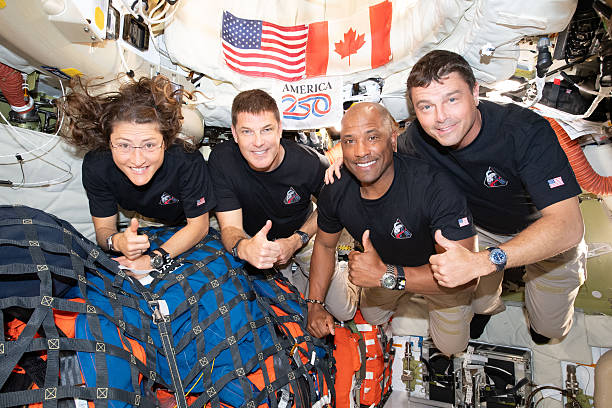
Aboard Orion are four brave astronauts, Commander Reid Wiseman, Pilot Victor Glover, and Mission Specilalists Christina Koch and Jeremy Hansen. This crew is especially important as Christina Koch is the first woman, Victor Glover is the first person of color, and Jeremy Hansen is the first non-american to fly into deepspace around the moon. Commander Reid Wiseman is a U.S. Navy aviator and previously the former chief of the Astronaut Office. And in 2014 he spent 165 days aboard the ISS. Pilot Victor Glover, U.S. Navy captain with more than 3,000 hours in 40 different aircrafts, piloting the SpaceX’s Crew-1 mission beforehand. Christina Koch, one of the Mission specialists, holds the longest single spaceflight by woman of 328 days. Working aboard as an engineer she participated in the first all-female spacewalk. Jeremy Hansen, the second mission specialist, is from the Canadian Space Agency and was a Royal Canadian Air Force fighter pilot, and Artemis II is his first spaceflight.
Artemis II launched at 6:35 p.m. EDT from a Launch Complex 39B at NASA’s Kennedy Space Center in Florida. The crew was up in space for ten days, using the Space Launch System (SLS) rocket, testing the accuracy of the systems for as we know future lunar landings and Mars missions. With each key milestone going smoothly, Booster separation, Core stage separation, Orion insertion into orbit. The launch was for public viewing and was livestreamed on NASA+, its YouTube channel, Tiktok, and other NASA social media platforms.
During their mission to the moon there were several instances during communication with the crew that sparked awe and wonder with avid watchers. Hansen announced during liftoff “We are going for all humanity” and descriptions of the moon. As “Flowery” “Gorgeous”, the crew were in awe of the moon and at times needed more words to descibe seeing the moon and earth outside the same window. Reaching a peak of 252,756 miles away from home, and even then did the laser communication work and astronauts were able to send back photos they had taken, down to earth. Notably Commander Wiseman, in honor of his late wife Carroll Wiseman, named a lunar crater after her, commemorating their historic journey.
On April 10th 2026, Orion broke through Earth’s atmosphere detatching from the service module at 400,000 feet with temperatures up to 5,000 fahrenheit. and splashed down in the Pacific Ocean near San Diego at 8:07 p.m. Eastern time. The four astronauts arrived safely, while there was trouble setting up the bridge to get them out, they were welcomed by the scuba diving teams. After landing they returned to Houston safely on April 11th.
Overall Artemis II was a huge milestone in American history, with a successful flight around the moon, naming the Caroll Crater, and proving Orion as fully functional.